Wednesday, March 14, 2012


Synthetic X Organic Textiles

The textile industry, according to the U.S. Energy Information Administration, is the 5thlargest contributor to CO2 emissions in the United States, after primary metals, nonmetallic mineral products, petroleum and chemicals.[

In 2008,  annual global textile production was estimated at  60 billion kilograms (KG) of fabric.  The estimated energy and water needed to produce that amount of fabric boggles the mind: •1,074 billion kWh of electricity  or 132 million metric tons of coal and •between 6 – 9 trillion liters of water.

 Textiles, including clothing, accounted for about one ton of the 19.8 tons of total CO2 emissions produced by each person in the U.S. in 2006. [4] By contrast, a person in Haiti produced a total of only 0.21 tons of total carbon emissions in 2006.[5]

The carbon footprint of various fibers varies a lot.

Once any material becomes a “yarn” or “filament”, the amount of energy and conversion process to weave that yarn into a textile is pretty consistent.

For natural fibers you must look at field preparation, planting and field operations (mechanized irrigation, weed control, pest control and fertilizers (manure or synthetic), harvesting and yields.

Synthetic fertilizer use is a major component of the high cost of conventional agriculture:  making just one ton of nitrogen fertilizer emits nearly 7 tons of CO2 equivalent greenhouse gases. For synthetics, a crucial fact is that the fibers are made from fossil fuels.   Very high amounts of energy are used in extracting the oil from the ground as well as in the production of the polymers.

Energy used (and therefore the CO2 emitted) to create 1 ton of spun fiber is much higher for synthetics than for hemp or cotton:
KG of CO2 emissions per ton of spun fiber:

crop cultivation
fiber production
TOTAL
polyester USA
0.00
9.52
9.52
cotton, conventional, USA
4.20
1.70
5.90
hemp, conventional
1.90
2.15
4.05
cotton, organic, India
2.00
1.80
3.80
cotton, organic, USA
0.90
1.45
2.35

Acrylic is 30% more energy intensive in its production than polyester [7] and nylon is even higher than that.

Embodied Energy used in production of various fibers:

energy use in MJ per KG of fiber:
flax fibre (MAT)
10
cotton
55
wool
63
Viscose
100
Polypropylene
115
Polyester
125
acrylic
175
Nylon
250


Natural Fibers decompose, while synthetic fibers do not.
Recycling requires costly separation, while incineration produces pollutants – in the case of high density polyethylene, 3 tons of CO2 emissions are produced for ever 1 ton of material burnt.[10] Left in the environment, synthetic fibers contribute, for example, to the estimated 640,000 tons of abandoned fishing nets in the world’s oceans.


PRODUCTION ENERGY
Embodied Energy in production of various fibers + processing:

energy use in MJ per KG of fiber:
energy use in MJ per KG of fabric
TOTAL energy use in MJ per KG of fabric to produce fiber + weave into cloth
flax
10
92
102
Cotton, convt’l.
55
92
147
wool
63
92
155
Viscose
100
92
192
Polypropylene
115
92
207
Polyester
125
92
217
acrylic
175
92
267
Nylon
250
92
342


That means that it takes 3,886 MJ of energy to produce 25 yards of nylon fabric, which is  about enough to cover one average sofa.  That compares to 1,158 MJ if the fiber you used was flax (linen).  To put that into perspective, 1 gallon of gasoline equals 131 MJ of energy; driving a Lamborghini from New York to Washington D.C. uses approximately 2266 MJ of energy.(4)

Organic fibers uses less energy for production, emits fewer greenhouse gases and supports organic farming. Organic farming systems used just 63% of the energy required by conventional farming systems, largely because of the massive amounts of energy requirements needed to synthesize nitrogen fertilizers. A study published by Innovations Agronomiques  (http://www.inra.fr/ciag/revue_innovations_agronomiques/volume_4_janvier_2009) found that fully 43% less greenhouse gasses are emitted per unit under organic agriculture than under conventional agriculture. A study done by Dr. David Pimentel of Cornell University found that organic farming systems used just 63% of the energy required by conventional farming systems, largely because of the massive amounts of energy requirements needed to synthesize nitrogen fertilizers.Further it was found in controlled long term trials that organic farming adds between 100-400kg of carbon per hectare to the soil each year, compared to non-organic farming. When this stored carbon is included in the carbon footprint calculation, it reduces total greenhouse gasses even further. The key lies in the handling of organic matter (OM): because soil organic matter is primarily carbon, increases in soil OM levels will be directly correlated with carbon sequestration. While conventional farming typically depletes soil OM, organic farming builds it through the use of composted animal manures and cover crops.
Taking it one step further beyond the energy inputs we’re looking at, which help to mitigate climate change, organic farming helps to ensure other environmental and social goals:
·       eliminates the use of synthetic fertilizers, pesticides and genetically modified organisims (GMOs) which is  an improvement in human health and agrobiodiversity
·       conserves water (making the soil more friable so rainwater is absorbed better – lessening irrigation requirements and erosion)
·       ensures sustained biodiversity
·       and compared to forests, agricultural soils may be a more secure sink for atmospheric carbon, since they are not vulnerable to logging and wildfire

WEAVING ENERGY

The processing is generally the same whether the fiber is nylon, cotton, hemp, wool or polyester:   thermal energy required per meter of cloth is 4,500-5,500 Kcal and electrical energy required per meter of cloth is 0.45-0.55 kwh. 

BUT, we have to consider environmental pollution.  Conventional textile processing is highly polluting:  • Up to 2000 chemicals are used in textile processing, many of them known to be harmful to human (and animal) health.  • The application of these chemicals uses copious amounts of water. In fact, the textile industry is the #1 industrial polluter of fresh water on the planet.

Organic Fibers uses less energy for production, emits fewer greenhouse gases, and supports organic farming (which has myriad environmental, social and health benefits).  A study published by Innovations Agronomiques  (http://www.inra.fr/ciag/revue_innovations_agronomiques/volume_4_janvier_2009) found that fully 43% less greenhouse gasses are emitted per unit under organic agriculture than under conventional agriculture. A study done by Dr. David Pimentel of Cornell University found that organic farming systems used just 63% of the energy required by conventional farming systems, largely because of the massive amounts of energy requirements needed to synthesize nitrogen fertilizers.  Further, it was found in controlled long term trials that organic farming adds between 100-400KG of carbon per hectare to the soil each year, compared to non-organic farming.  When this stored carbon is included in the carbon footprint calculation, it reduces total greenhouse gasses even further. The key lies in the handling of organic matter (OM): because soil organic matter is primarily carbon, increases in soil OM levels will be directly correlated with carbon sequestration. While conventional farming typically depletes soil OM, organic farming builds it through the use of composted animal manures and cover crops.

At this point in time, given the technology we have now, an organic fiber fabric, processed to GOTS (Global Organic Textile Standard (GOTS) standards, is (without a doubt) the safest, most responsible choice possible in terms of both stewardship of the earth, preserving health and limiting toxicity load to humans and animals, and reducing carbon footprint – and emphasizing rudimentary social justice issues such as no child labor.

There are no natural fiber fabrics made in the United States which are certified to the Global Organic Textile Standard (GOTS).

In 2006, their work was published as the Global Organic Textile Standard (GOTS) , which has since evolved into the leading set of criteria in the field of organic textile processing.  A main achievement of this group was the ability to compromise and to find even consensus GOTS aims to define a universal standard for organic fabrics—from harvesting the raw materials, through environmentally and socially responsible manufacturing, to labeling—in order to provide credible assurance to consumers. Standards apply to fiber products, yarns, fabrics and clothes and cover the production, processing, manufacturing, packaging, labeling, exportation, importation and distribution of all natural fiber products.   GOTS provides a continuous quality control and certification system from field to shelf.  A GOTS certified fabric is therefore much more than just a textile which is made from organic fibers.

Monday, March 12, 2012

possible titiles for exhibit

Unraveled
            : a conversation about the embodied energy of textiles
     or     : a conversation about the environmental impact of textile production
      or    : a conversation about C02 emissions and textile production

From All Directions: the inescapable facts about C02 emissions

Loose Ends: unraveling the complicated effects of textile production

Blanket Approval
Threads of thought: making responsible choices in textiles
Common Threads
Hanging by the Threads
Loose Threads
Pulling Threads
Choosing Textiles Responsibly
Binding Considerations: Choosing Textiles Responsibly
Global Warp
On the Ropes
Raw Material
Raw Details
How did we get here?
Refocus: changing the way we look at textiles
The Real Threadcount: unraveling the truth behind textile manufacturing
    or   unraveling the environmental impact of textile mfg.
Thread Countdown
Thread Count: How fiber choice matters
Counting the Threads: choosing textiles responsibly
Decoding Green
Starting with the end in mind: a thoughtful approach to reducing C02 emissions of textile production
Cleaning up our Act: choosing textiles responsibly

Friday, March 09, 2012

Fact for the day, from "The supply chain of CO2 emissions" by Steven J. Davisa,1, Glen P. Petersb, and Ken Caldeira:
10.2 billion tons CO2, or 37% of global emissions, are from fossil fuels traded internationally and an additional 6.4 billion tons CO2 or 23% of global emissions are embodied in traded goods.

Tuesday, March 06, 2012


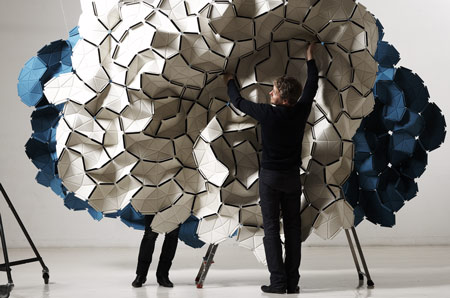
Maybe something similar instead of the balloons for a wall graph...?  

Monday, March 05, 2012


Derick Melander, sculptor of used clothing

My thoughts for class today

Hi everyone. Sorry to miss today. After more reading and getting even more bogged down in the enormity of environmental problems, I realized that the only message I was SURE of was to encourage designers (and everyone, really) to use local manufacturing sources when choosing products - whether carpeting, wall coverings, furniture or building products.  It won't be possible to buy EVERYTHING from local sources when providing commercial services, but it's a good place to start, so that's my message. Start with local sources, and work your way out.  I'm still trying to come up with my exact title/slogan/message, so I just started writing down thoughts. If anyone else is thinking along these lines, maybe you can improve or expand upon one of these.

YOU ARE HERE - so is most of what you need.
I keep thinking about the star on a map. There might be a better following tagline. But I want it to communicate to start where you are. This could tell the story of how buying goods and services locally can have a huge environmental impact as opposed to buying all imported goods. I think this goes with everything we've been discussing about the visuals.

Buying Local - It's bigger than you think

Buy Local - Impact the World

Save the Planet - Buy Local
 

Local Hero
 

Design Hero - Use Local Sources

Join the buy local revolution

Join the Design Revolution - Use Local Sources

Strategic Sourcing | Environmental Impact

Think Globally, Design Locally

Join the big picture by taking a small step - commit to buying locally & regionally

Think before you buy


I guess my favorites of these are You Are Here (because I feel like this could expand)
and one of the "hero" ideas, Design Hero or Local hero (it could expand also, but it implies that the designer/consumer has power, instead of being helpless to make a change). I'll look forward to hearing what you discuss. I will say that I like the "Everything Must Go" exhibit on recycling and I will read Katia's post.


One other thought I had as I was reading was "The Hidden Cost of Cheap" I came across a reference to this concept on the OECOTEXTILES blog.

See you Wed.

Sunday, March 04, 2012

THE PSYCHOLOGY OF CLIMATE CHANGE

http://cred.columbia.edu/guide/pdfs/CREDguide_full-res.pdf

Wednesday, February 29, 2012

Monday, February 27, 2012

Sunday, February 26, 2012

#1: Choose better problems to solve Mike Monteiro's new years resolutions for designers.

Friday, February 24, 2012

Wednesday, February 22, 2012

Tuesday, February 21, 2012

Study on The Carbon Footprint of Textiles  –  Berlin | July 5th, 2010


http://www.ci-romero.de/fileadmin/media/informieren-themen/gruene_mode/Jungmichel._Systain.pdf

A whole blog dedicated to Carbon footprint of the textile industry!


Monday, February 20, 2012

234 tonnes of textiles are discarded into Hong Kong landfills according to Hong Kong’s Environmental Protection Department. 
Redress(rÄ“′dres′) to set right; remedy or rectify

Design Lessons From India's Poorest Neighborhoods


Interesting article!

http://www.stumbleupon.com/su/2AN609/www.fastcompany.com/1723213/grassroots-innovations-from-urban-india-find-their-way-to-new-york-city/

Thursday, February 16, 2012

How can a gallon of gasoline produce 20 pounds of CO2?
It seems impossible that a gallon of gasoline, which weighs about 6.3 pounds, could produce 20 pounds of carbon dioxide (CO2) when burned. However, most of the weight of the CO2 doesn't come from the gasoline itself, but the oxygen in the air.

When gasoline burns, the carbon and hydrogen separate. The hydrogen combines with oxygen to form water (H2O), and carbon combines with oxygen to form carbon dioxide (CO2).

CO2 molecule with one carbon atom (atomic weight 12) and two oxygen atoms (atomic weight of 16 each)A carbon atom has a weight of 12, and each oxygen atom has a weight of 16, giving each single molecule of CO2 an atomic weight of 44 (12 from carbon and 32 from oxygen).

Therefore, to calculate the amount of CO2 produced from a gallon of gasoline, the weight of the carbon in the gasoline is multiplied by 44/12 or 3.7.

Since gasoline is about 87% carbon and 13% hydrogen by weight, the carbon in a gallon of gasoline weighs 5.5 pounds (6.3 lbs. x .87).

We can then multiply the weight of the carbon (5.5 pounds) by 3.7, which equals 20 pounds of CO2!
RESOURCE 

http://www.extension.iastate.edu/agdm/wholefarm/html/c6-86.html

Wednesday, February 15, 2012

big balloon color chart

see also balloon ideas from balloons denver
spray-chalk from abrivo sports

Advice from a forum about chalk on Instructables.com
Quick chalk/construction lesson for anyone interested:

Hardware stores especially the bigger contractor oriented ones sell powdered chalk. You can buy it in sizes and bottles like your old fashioned ketchup or mustard squeeze bottle, or in sizes/shapes equivalent to the costco/price club jumbo size condiment squeeze bottles.

The most easily found are blue, red, black and white.

Blue fades the quickest, which is useful for things that will get painted or where you want to be able to wash it off or simply don't want the chalk to transfer from one surface to another.

Red is more durable and harder to clean off and can transfer.

Black is not really chalk and it contains graphite, among other things IRC, and is the longest lasting. It transfers. If you're not careful it can be like cancer; once it starts spreading, you can't stop it.
Black and red require real scrubbing when you get them on your skin; especially black.

In concrete forming we tend to use black and red, but we will use blue chalk on the surfaces of the forms if the concrete will be left exposed ('architectural'), this way if chalk transfers from the plywood to the concrete, it will be more easily removed and/or less noticeable.

I've only ever used white chalk once when I had to cut out some relatively fresh asphalt (the other colours don't show so well on the black surface). I cut up those chalk lines, so they didn't have a chance to last so I can't tell you anything about durability, but I assume it's like the blue, because it's "real" chalk.

When we need chalk lines to stand up to the weather (longer term layout purposes), we use a clear marking paint (spray can that works inverted, usually in day-glo colours) to seal it (or we use an acrylic sealant with can spray can like they pest control people use). But that might be bordering on vandalism.

If you need colours not found in the hardware store, you can buy buckets of chalk 1" diameter in assorted colours, in toy departments, this chalk may get you in less trouble than construction chalk and it's probably much less durable.

If you wanted, you could use something like a coffee grinder, blender or food processor to powder chalk sticks (start with a 'crush ice' setting) - maybe fold them in a cloth and break 'em up a bit with a hammer first.

Monday, February 13, 2012

Wednesday, February 08, 2012

Tuesday, February 07, 2012

Bator's article talks specifically about how to change people's attitudes about the environment. Try to get a look at it to talk about by next week if not by tomorrow. - Liz

Friday, February 03, 2012

Moving up the foodchain:
If you are concerned that your turning off lights, recycling paper, etc., doesn't make a significant difference, your audience may feel that way about their own actions -- at least I think we all agreed to this concern in our discussion Wednesday.
How can you help your audience move "up the foodchain" of influence? What if you gave visitors to the exhibition signs to post outside elevators reminding OTHER people to take the stairs and use less energy? How else could you empower them to influence others?

Wednesday, February 01, 2012

Liz's favorites on flickr
Some of these images are part of much larger bodies of work, so if something appeals to you, click on the photographer's photostream on the right side of the screen.

Monday, January 30, 2012

Wonderroot
would make space available to us for free, and wouldn't charge any commission on work sold. It sounds like March 10 to April 30 are mostly open - they will let us know soon about exact dates. The main floor has two adjoining rooms, total space about 14' x 35' with a 4' x 12' table that needs to stay in place. If you have a show there they'd like to keep it up for 3 to 4 weeks.
WR is open daily noon to 10 pm so we could go by there at some point.

Friday, January 27, 2012

The Game Plan: A solution framework for the climate challenge

The slideshow is long, so you might want to skip right to Griffith's visuals


Thursday, January 26, 2012

Better Than Brainstorming
from The New Yorker Magazine: Jonah Lehrer looks at the science behind teamwork. Here Lehrer talks with Blake Eskin about why brainstorming doesn’t work, and why encouraging criticism and coffee breaks does.
48 hour repack competition Feb 24 through 26

Flyer here

Wednesday, January 25, 2012

From Yue:
  1. Recycling battery
  2. Trash classification, learn from Japan
  3. Turn off the lights when you go out of room
  4. Ebook replaced paper book
  5. Encourage using public traffic one time a week instead of driving car everyday
  6. Stop using plastic bags and food container in market or restaurant
  7. Compare environment of three or more decades or generations
  8. Use aluminum cans or other trash to create sculpture
  9. Compare the quantity of electricity using for both energy-saving lamp and regular
  10. The current situation of people in industrial district or city
  11. What can we do by recycling paper
  12. We provide fabric supermarket bags and let children paint on the bags
  13. Use trash to create painting
  14. How the printing destroy environment
  15. ECO and CO
  16. Painting or recreate trash can
  17. Stop wasting water

Monday, January 23, 2012

Sunday, January 22, 2012

from Katia:
1. Junk Mail Life cycle and it's weight in society (building paper bricks)
2. Appliance usage and consumption ($)
3. Using Junk mail to build banners with sustainability information
4. Waste materials X landfill x water ways.
5.Collaborations yields result: one person can make a difference
6. What have we lost? How is our earth degenerating? What is the next generation not going to see? Change today for your children tomorrow
7.Technology Impact in 10 years
8. Individual behavior can change the world: 51 little everyday habits to save the world
9. Recycle art - build art sculpture/pieces with recycled material
10. Consumerism X anti-consumerism
11. The supermarket bag: why not to use it?
12.What is CO2 and your contribution (in easy to understand terms using everyday items)
13. Packaging and its consequence on the environment: Pretty but deadly!
14. Milk jugs, cans, card box packaging, junk mail _ 3 months collection _ A visual truth.
15. What do you through in the trash? What is biodegradable and what is not? What is you inheritance to your children?
15. Overpopulation X pollution: The lack of infrastructure.
16. Creativity_100 things we can do with aluminum cans, plastic bags, etc
17. The effects of green communities
I also thought about getting the seniors/juniors to work with us and developing Earth Day posters with educational facts that coud be displayed in the exhibit... Just a thought.
Below are some interesting videos:
This is a series of videos on carbon. Really easy to understand!!
It's all about carbon
I also thought this video was really interesting:
NASA: 2011 Temperatures

Theme Ideas

Wednesday, January 11, 2012

Discussion notes: make it
~ Personal
~ Vivid
~ Empowering
~ Interative
~ Address audience

Tuesday, January 10, 2012

Slideshow from Monday
Thanks Katia for the tip on making it a pdf: shrunk to about 18% of original size!

Monday, January 09, 2012

Sunday, January 08, 2012

As you read the following three articles, note any difficulties you find in absorbing the information. After reading them, what would you tell a friend who was considering buying an Apple computer?

How Green is Apple?

Apple Computer on its environmental impact

Carbon Footprint of a Macbook

Wednesday, January 04, 2012

Tuesday, January 03, 2012

The Value of Data Visualization from Column Five on Vimeo.

btw it may load VERY slowly

Tuesday, January 05, 2010

January 12th Early Registration Deadline Approaching!

The third biennial NC State Master of Graphic Design graduate symposium is just around the corner. We want to hear what you have to say!
The time: January 22–23, 2010
The place: College of Design, North Carolina State University, Raleigh, North Carolina, USA
The topic: The rhetoric of authenticity within design practices and for community experience
Register Early and Save!
Our website is up and running, complete with information on registration, travel, and lodging. A tentative schedule and further information on the weekend’s speakers and events can be found there. Please be aware that seating is limited, so we encourage you to register now.
Registration fees through January 12: Graduate Students ($34.99), Educators and others ($64.99), and Friday night only ($9.99)
After January 12: Graduate Students ($44.99), Educators and others ($79.99), and Friday night only ($14.99)
Call for Student Panel Participants
We’re searching for graduate students interested in serving as part of a concluding panel to reflect on the events of the symposium weekend. The panel will take place at the closing of the symposium program, Saturday, January 23rd. If you’re planning on attending and would like to participate on the panel, please contact David Raymond (dsraymon@ncsu.edu) for more information.
Share Your Work
We’ll be holding an informal graduate student work-sharing session on Sunday morning, January 24th. This casual affair will provide an opportunity for students to talk about the work they’ve produced at their programs and see what other grad students in design are making and doing. If you’re interested in participating, please contact Tania Allen (tanialallen@gmail.com).

Official call for participation
From the built environment to the virtual realm of interface, design persuades individuals and communities of the truth, honesty, and realness of objects, spaces, and systems. These tactics of persuasion amount to what may be called a rhetoric of authenticity. Though designers employ this rhetoric, communities ultimately decide what is authentic to them.
Design anthropologist Dori Tunstall describes five requisites of communities: commonality in terms of historic consciousness, life goals, organizational structures, relationships, and conceptions of individual agency. Can considering how the rhetoric of authenticity relates to these defining characteristics of communities help identify points of engagement with complex and discriminating audiences?
This symposium will explore the rhetoric of authenticity within design practices and for community experience. We will confront provocative issues relating to designers’ roles and responsibilities to communities and the individuals who comprise them. Join us in this dialogue.
NC State’s Third Biennial Graduate Symposium in Graphic Design is brought to you by the grad students: Brooke Chornyak, Cady Bean-Smith, Caroline Maxcy Prietz, Dan McCafferty, Kelly Bailey, Lauren Waugh, Liese Zahabi, Lincoln Hancock, Rebecca Knowe, Ryan Gottfried, Samyul Kim, Sidney Fritts, Tania Allen, TJ Blanchflower, Tony Fugolo, Gary Dickson, David Raymond, and Laura Rodriguez. Plus Denise Gonzales Crisp, Graduate Symposium Advisor; Meredith Davis, Director of the MGD Graduate Program; and Santiago Piedrafita, Head, Graphic Design and Industrial Design Department.
Kyle Cooper to appear at The Plaza Wed., Feb 3

Thursday, December 17, 2009

This is an excellent oppty to share your insights. Let me know if you need help getting a proposal together - Liz

The Welch School of Art and Design’s Gallery is organizing a
symposium on Friday February 12, 2010 in celebration of Black History
Month. Graduate and undergraduate students from all GSU departments
are invited to present papers that address any of the following areas
as they pertain to the African and African American artistic experience:
Journey, Representation, Autobiography, Spirituality, Identity,
Critical Perspectives, Race, and Visual Culture. By assembling a
diverse set of papers without temporal or geographical guidelines, the
symposium strives to highlight the variability and complexity of African
and Diasporic cultural and artistic legacies.

Paper presentation time should not exceed 20 minutes. The symposium
space will be equipped to project digital images. Support will be
available for students who wish to receive assistance in polishing their
presentations prior to the symposium.

Please email Waduda Muhammad or Dr. Kimberly Cleveland with paper
topics by 5:00pm Friday December 18, 2009 if you are interested in
participating.

Wednesday, November 18, 2009

Thursday, November 05, 2009

PREPARING DESIGNERS FOR A CHANGED MARKET
Location: SCAD-Atlanta, Room 4C
Date: Sat, Nov 7
Time: 9:30 AM - 1:00 PM (come early to sign in or register)
FREE
A must attend event for all graphic design students!

This program is tailored for all Atlanta area graphic design students to learn about the current conditions of the graphic design market place and what they can do as students to prepare for their future careers.

Monday, September 21, 2009

Art & Copy
A Film About Advertising and Creativity
Wednesday, September 23rd
7:45 pm
The Plaza Theatre
An AIGA Special Film Screening
Student Members $6.50
Members $6.50
General Admission $8.00

Wednesday, August 26, 2009

“Embrace the Depot”

Depot by definition stands for ‘a storage space’ or ‘warehouse’.


Office Depot can successfully build stronger brand equity through a 360 degree ‘warehouse’ experience by creating visual continuity across retail display, product packaging, and storage components; by utilizing vertical space with complementary lighting, sound, temperature and visually compelling hangings; by providing interactive, mixed product displays that engage customers and enhance consumer experience.

Wednesday, August 19, 2009

Office Depot locations Atlanta

Office Max locations Atlanta

Staples Atlanta
[The spectacle] implies some sort of circus or show put on by a few and watched by the masses who stare dumbfoundedly in amusement and amazement. It implies control and passivity, separation and isolation. The "show," in fact, is modern society: "The entire life of societies in which modern conditions of production prevail announces itself as an immense accumulation of spectacles" (Debord, The Society of the Spectacle, p.1). The term spectacle subsumes all the means and methods power employs, outside of direct force, to relegate potentially political, critical, and creative human beings to the margins of thought and behavior. The spectacle then is depoliticization par excellence: "The very principle of the spectacle is nonintervention" (S.I. Anthology, p.45). Mesmerized by the wide array of "diversions" offered by the spectacular society, from goods and services to entertainment and conveniences, human beings stray far from the most critical task: changing the world and liberating everyday life. In the meantime, bureaucratic domination refines and perfects its techniques.
– from Drifting with the Situationist International, Anonymous

Monday, August 17, 2009

There is Such a Thing as Society
The major artistic movements of this century—the futurists, constructivists, dadaists, surrealists—all had a theory of society that guided their explorations. The exploration of the formal structure of language—its signs, symbols, and how these construct and carry meaning—should be the staple diet of designers. Language is a means through which we express our consciousness of ourselves and our relationship to the world; it is our attempts to describe our situation and to think about the future that lead us to search for appropriate vocabularies. Language changes when it is no longer able to express what its users require of it, so unless it is to be of academic interest only, an exploration of language must also take into account the changing consciousness of human beings. It is difficult to comprehend the point of exploring form if it is not related to contemporary problems of vocabulary and the search for meaning. The study of visual form and language is limited if it does not consider the forces of cultural production, which involve a set of social relations between producer and audience.
­— Andrew Howard, 1994.

Wednesday, May 27, 2009

Consequential Matters opens June 15 at CDC
SMOG IS DEMOCRATIC
Jonathan Lukens and Carl DiSalvo
Smog is Democratic explores particulate matter through the medium of visualization. As we inhabit and wear away at the city, we produce dust and debris. As plants attempt to reproduce, they release pollen. These and other processes create particulate matter, a residue of life. An investigation of particulate matter touches multiple concerns: pollution, the relationship between urban living and hygiene, the tension between scientific and artistic representations of information, and the desire to produce measurement techniques that gauge the threat of the unseen. This installation is interpretive and expressive, with the goal of considering how the sources and measurements of particulate matter might be rendered in order to generate reflection, discussion, and debate.

Friday, April 24, 2009

Wednesday, May 13th, 7pm
The Museum of Design Atlanta (MODA) invites you to a special screening of Objectified--Part of the MA "Design is Human" Event and Home Tour.
Plaza Theatre 1049 Ponce De Leon Ave. Atlanta GA 30306
Post-screening Q&A with director Gary Hustwit and special guests. Presented by the Museum of Design Atlanta, AIGA Atlanta, and IDSA Atlanta. Tickets $20 general public, $15 for AIGA, IDSA, and Museum of Design members.
MA (Modern Atlanta) 09 Design is Human will feature:
* Modern Home Tours May 16-17
* MA Launch Party, Architect Models and Renderings, and Modern Design Exhibit featuring local designers and student work from GA Tech at White Provision
* MA ology Italian Design Event, Fashion Show & Fundraiser for CARE at White Provision featuring the paintings of Marco Grassi, fashion by Jeffrey and a exhibit of the iconic Sacco Chair by Zanotta
* MA Talks at The High Museum featuring the Metropolitan Home Magazine panel discussion on CRAFTdesign‚ with their Creative Director Linda O’Keeffe, and a presentation by Architect Anthony Ames
* Objectified documentary screening sponsored by MODA, AIGA Atlanta, ASID Atlanta and MA
* MA Film Series at The High Museum featuring Koolhaas/Houselife by Rem Koolhaas and City of Dreams
* An evening and book signing with renown designer Clodagh at DEX Studios
* Modern art show and reception in the modern flat designed by architect Robert Trestch at The Mansion on Peachtree
* Open House at Portfolio Center featuring a talk by Dragon Rouge founder Marcus Hewitt
* New product launches, inspiring talks and receptions at SieMatic, bulthaup and Poggenpohl
* And much more‚ ¨

Monday, April 13, 2009

DETAILS, DETAILS Thursday, April 30th
AIGA Members: $10 adv. / $15 at door
AIGA Student Members: $5
Non-Members: $15 adv. / $20 at door

Doors 6PM, Lecture 7PM
Ellen Lupton's Design Rant! Learn what�??s wrong with dumb quotes, hotel rooms, roller bags, the food pyramid, and more, much more. Ellen Lupton is obsessed with promoting design thinking and design practices to general audiences: writers, artists, kids, working fathers, and radical housewives. The D.I.Y. movement is part of the future of design; it is affecting every intellectual industry, from politics and journalism to music and rocket science. How is it affecting you? Designers are becoming evangelists of their own expertise, as well as breaking into countless new fields themselves that once were protected by barriers of professional knowledge. Today, anyone can be a designer (if they try)�??or a publisher, pundit, rock star, or filmmaker.

Tuesday, February 10, 2009

Grad Student Conference
Deadline extended for Politics of Consumption and Leisure Conference
Location: Illinois, United States
Call for Papers Deadline: 2009-02-10
The Politics of Consumption and Leisure

The History Graduate Student Association of Southern Illinois
University-Carbondale HAS EXTENDED ITS DEADLINE FOR PAPERS for its 4th
Annual Conference on April 10-11, 2009. Dr. Eric Reed, noted historian of
the Tour de France, will give the keynote. We are seeking papers on
historical aspects of consumerism, consumption, and leisure activities.
Though criticisms of material, intellectual, and leisure culture are
timeless, investigations of these topics illustrate broader patterns of
cultural, social, and political attitudes and beliefs. Papers that address
marketing/advertising, commercialization, and the growth of consumer
culture, and leisure time, or contemporary critiques of these themes from
the early modern period (c. 1450 CE) to the present from any area of
European, American, or World history are encouraged to submit.
Topic areas may address, but are not limited to:
-Gender, race, class and religion
-colonialism/imperialism or anti-colonial/imperial/revolutionary movements
-food and drink
-nationalism and the state
-elite vs. popular consumption and leisure activities
-sport and recreation
-fashion and clothing
-creative arts (music, film, literature, dance)
-social circulation of ideas and attitudes
-visual culture (monuments, artwork, architecture)
-medicine and health
-technology and/or media
Please send a 100-150 word abstract of your 15-20 minute paper/presentation,
a brief CV, and a list of any audio-visual needs to Donovan Weight by
February 10, 2009.
Donovan Weight
Faner 3321
Southern Illinois University Carbondale
Carbondale Illinois 62901
Email: dweight@siu.edu

Thursday, February 05, 2009

April 24th deadline for entries
Create print and Internet Yellow Pages advertising for a Yellow Pages advertiser -- No entry fee.
$10K in prizes!

Check out the winners from previous years - you can do better! Let me know if you want to participate - I am happy to be Faculty Sponsor, and will donate any prize money to the GSU Graphic Design program. - Liz

Friday, January 30, 2009

Sorry -- thought this was already available:

Keith Smith: Time in Books

This is directly from the book and includes pictures. The entire book is available in the Pullen library:
Keith A. Smith
Structure of the Visual Book, 3rd Ed., 1996
- L

Saturday, January 10, 2009

Or if you don't feel like downloading chapter 1 of Language of Vision, you can read most of it in GoogleBooks
here

Friday, January 09, 2009

Part one of "Plastic Organization"
Part two of "Plastic Organization"
At long last this chapter from Gyorgy Kepes' Language of Vision

Thursday, January 08, 2009

Jessica Helfend, Wm Drentell at PC Monday Jan 12th
FREE
Join us at Portfolio Center with William Drenttel & Jessica Helfand, Winterhouse
Monday evening, January 12th at 6:30pm
@ Portfolio Center
125 Bennett St., Atlanta, GA 30309

Winterhouse Studio focuses on publishing and editorial development; new media; and cultural, educational and literary institutions. Design work for Teach For All, The New Yorker, Yale University Press, The New England Journal of Medicine, Errol Morris, Smithsonian Archives of American Art, Poetry Foundation, among others.

Friday, January 02, 2009

Museum of Design to host Graphic Imperative in May
May 15 – August 15 (Patron Opening May 14)
The Graphic Imperative is a select retrospective of forty years of international sociopolitical posters. Themes include dissent, liberation, sexism, human rights, civil rights, environmental and health concerns, AIDS, war, literacy and tolerance, collectively providing a window to an age of great change.
MODA
Design for the Other 90%
February 17 – May 29, 2009
Of the world’s 6.5 billion people, 90 percent have little or no access to most of the products and services many of us take for granted. In fact, nearly half do not have reliable access to food, clean water, healthcare, education, affordable transportation, or shelter. The exhibition Design for the Other 90% features more than 30 projects that reflect a growing movement among designers, engineers, and social entrepreneurs to create low-cost solutions for everyday problems. Through local and global partnerships, individuals and organizations are finding unique ways to address the basic challenges of survival and progress faced by the world’s poor.

Design for the Other 90% showcases designs that incorporate new and traditional materials, and abandoned and emerging technologies to solve myriad problems—from cleaner-burning sugarcane charcoal to a solar-rechargeable battery for a hearing aid, from a portable water-purification straw to a low-cost laptop. By understanding the available resources and tools as well as the lives and needs of their potential users, these designers create simple, pragmatic objects and ingenious, adaptive systems that can help transform lives and communities.

Wednesday, December 31, 2008

An Evening of Stop-Motion Puppet Films
Saturday, January 17, 2009, 8pm
Ages 18 and up ONLY
Come enjoy the end result of countless hours of painstaking puppet manipulation captured on film one frame at a time as we celebrate an evening of stop-motion puppet animation. The evening includes Adam Elliot’s Academy Award-winning Harvie Krumpet from Australia, Haunted Hogmanay from Ko-Lik Films of Scotland and more.
Center for Puppetry Arts

Cost: $7; $5 Center Members

Saturday, May 31, 2008

"After 1968" features "Unbranded" work by Hank Willis Thomas

This summer at the High Museum of Art
After 1968: Contemporary Artists and the Civil Rights Legacy
June 7–October 5, 2008

Hank Willis Thomas
Hank Willis Thomas, born 1976, appropriates images and language from advertising, exploring the intersection of commerce with the cultural ambiguity underlying African American experiences. His 2004 thesis, Swoosh: Looking Black at Nike, Moses, and Jordan in the ’80s, explores the process whereby a myth or image can become attached to a graphic symbol. His soon-to-be-completed Unbranded series is an exploration of racial typing in capitalist culture. Reproducing 80 images printed between 1968 and 2008 in popular magazine ads targeted to black audiences, “Unbranded” presents text-stripped images, meditating on the creation and dissemination of stereotypes.

Tuesday, January 15, 2008

Monday, January 14, 2008

On Non-Verbal Representation by Donald Brook in the British Journal of Aesthetics
Schenck, Ernie. "The Cave of The Forgotten Word." Communication arts 49.4 (2007):214-216.

In the Cave of the Forgotten Word

Wednesday, December 06, 2006